



Investor Brief 2026/2027
Autonomous, Pressure-Controlled Limb Perfusion
The first purpose-built system to directly measure and actively control distal limb perfusion pressure during high-risk femoral mechanical circulatory support and other planned arterial obstruction procedures.
Paris, France, Incubated by Sofinnova MD Start
The Problem
Femoral arterial support can sharply reduce the pressure reaching the distal limb. In MCS, acute limb ischemia is driven by lost distal pressure—not simply access size—making the problem measurable and potentially preventable. Today’s distal perfusion catheters are passive and blind: they do not directly measure distal pressure, adapt to changing physiology, or actively maintain perfusion.

Acute Limb Ischemia rates reach 8–33% in selected femoral MCS settings.
ALI is associated with markedly higher in-hospital mortality—57% versus 38%- and adds +$280K in hospital charges. There is no purpose-built prevention today.
57% vs. 38%
In-hospital mortality: ALI vs. no ALI
+
+8 hospital days | +3 ICU Days | +Up to a $3M complication cost per event
Why now?
Growing utilization of temporary femoral MCS
Intravascular pressure sensing is now feasible
Hospitals already bear substantial ALI-related cost
A defined De Novo regulatory pathway is under active FDA discussion
How Tulyp Works
Active prevention and treatment — not reactive rescue
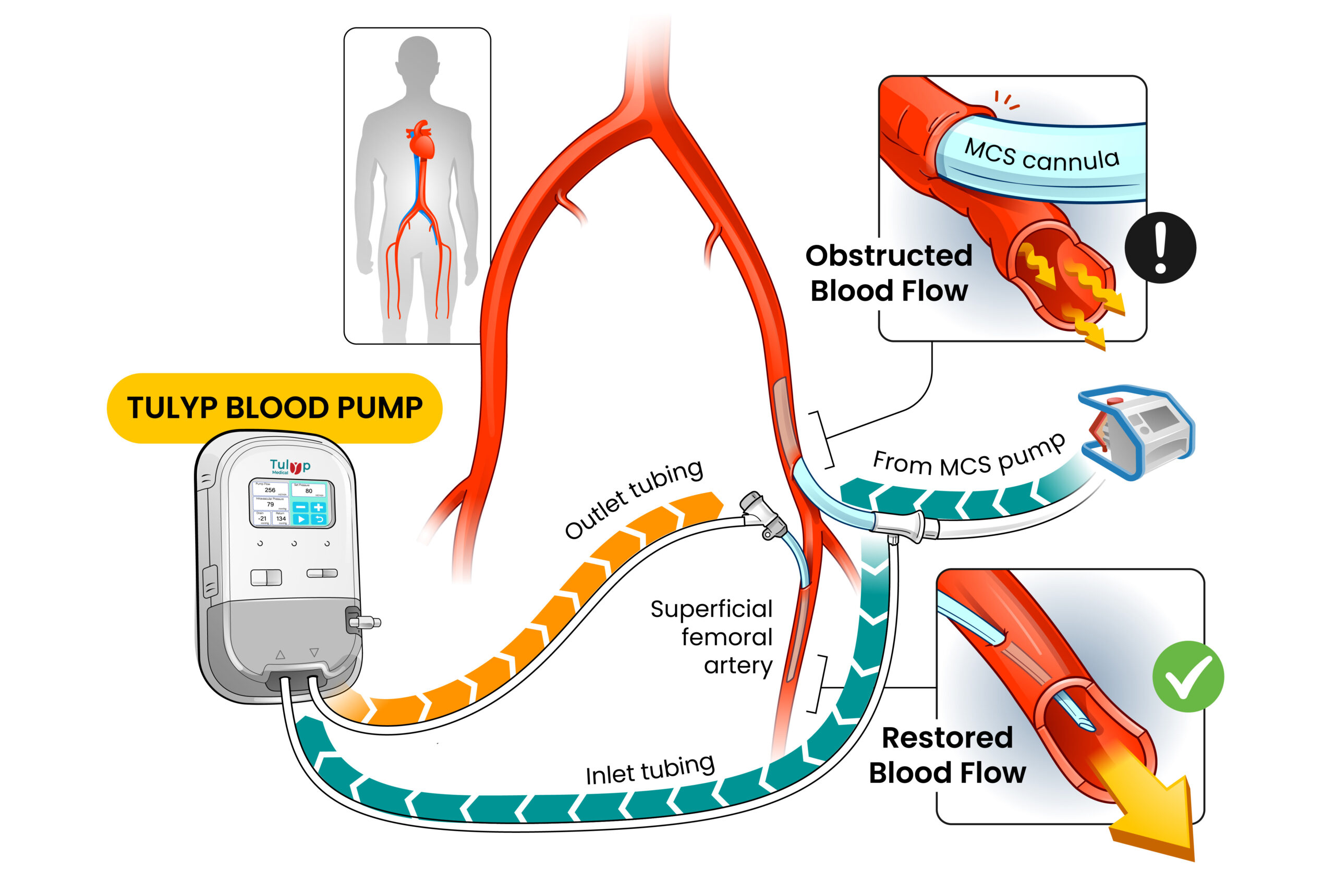
Tulyp measures distal intravascular pressure through a pressure-sensing perfusion catheter and autonomously titrates pump flow to maintain a clinician-defined distal pressure target—restoring and maintaining limb perfusion in real time. Sense: direct intravascular pressure Control: closed-loop flow adjustment Protect: target distal pressure maintained
9 preclinical and 9 first-in-human cases completed
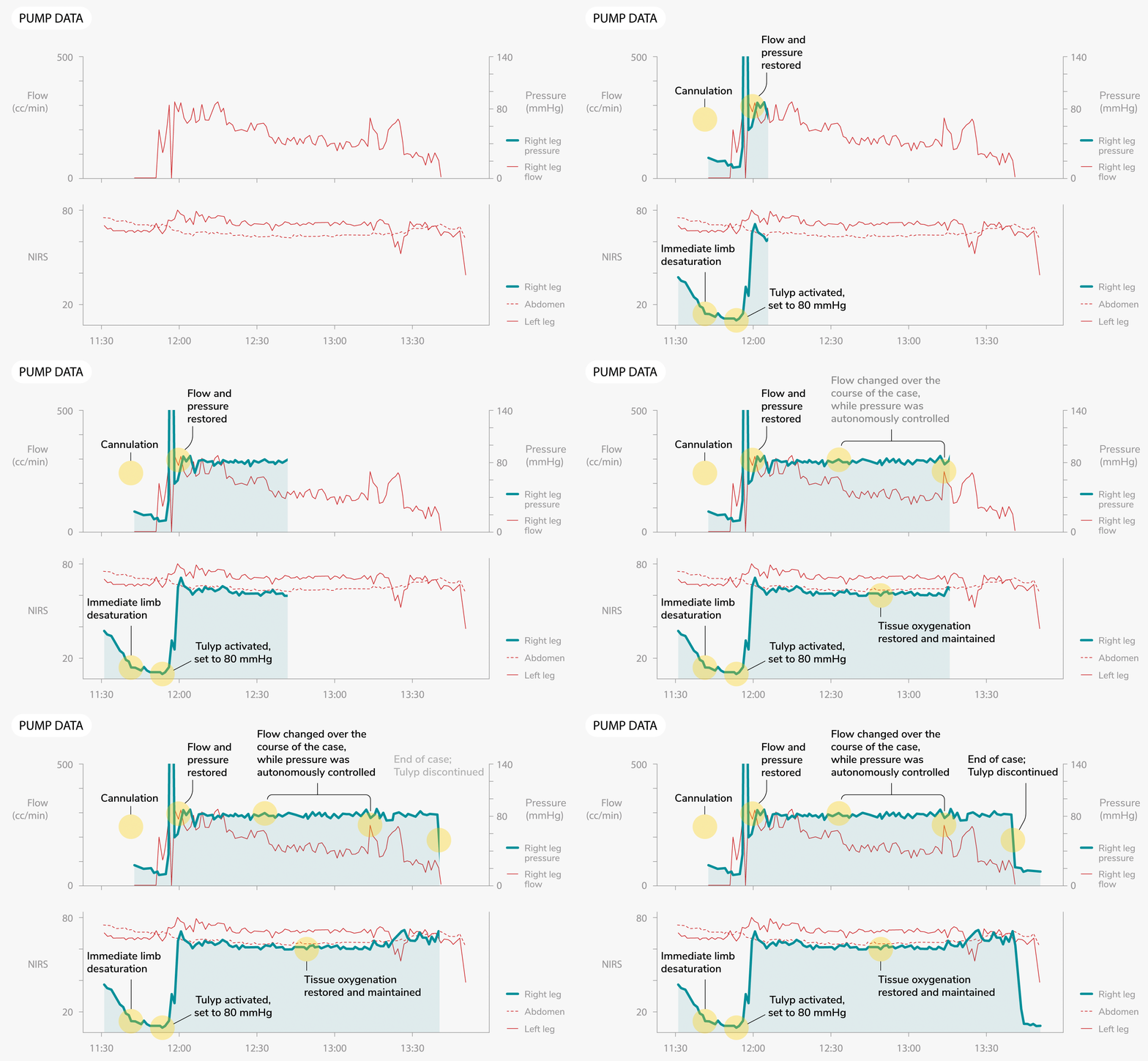
In the six-patient occlusive femoral MCS cohort, Tulyp maintained target distal pressure and restored tissue oxygenation. No device-related adverse events were observed. Publications pending.
100% restoration of tissue oxygenation
Autonomous pressure control maintained
No device-related adverse events
Limb ischemia shouldn’t be the price of circulatory support and planned femoral arterial obstruction procedures. Tulyp is making active limb protection the standard of care.
The Market
Tulyp’s pressure-controlled technology is designed for any procedure in which maintaining adequate distal perfusion is critical.
$217M base-case U.S. serviceable market
Approximately 72,400 clinically eligible high-risk femoral MCS cases annually at a $4,500 blended ASP. Initial applications include peripheral femoral VA-ECMO, selected high-risk femoral microaxial pVAD, combined ECMO+pVAD support, and other prolonged femoral MCS cases where risk can be prospectively identified.
$1.2B future U.S. platform opportunity, $3.3B Globally
Evidence-driven expansion into structural heart, aortic and vascular procedures, peripheral interventions, and other femoral arterial-access applications.
Concentrated launch market
The top 200 centers represent nearly half of eligible volume
+$280K in additional hospital charges per event
Avoided per case prevented (CMS MedPar 2023)
Key Milestones Achieved - Why Tulyp Wins
- 9 first-in-human cases completed
- Autonomous pressure control demonstrated in humans
- 9 preclinical studies completed
- U.S. patents granted
- First-in-human results submitted for publication and accepted at ESC, and TCT
- Proven leadership team assembled with multiple exits
CURRENT STANDARD
- Passive tubing
- No sensing
- Manual adjustment
- Rescue after injury
TULYP
- Active perfusion
- Continuous pressure sensing
- Autonomous control
- Prevention before injury
Evidence, Development, and Regulatory Roadmap
First-in-human complete → FDA Q-Sub, GLP evidence, and De Novo clearance → Complete system U.S. launch in 2029

Seeking $10M Series A funds the company through regulatory approval
Proceeds fund:
- Gen II pump development and manufacturing validation
- PS-DPC, display, tubing, and system verification and validation
- GLP evidence, regulatory execution, and funded clinical fallback
- Team, operations, and initial launch preparation
Tulyp Leadership
Multiple exits in cardiovascular medtech, deep domain experience in cardiogenic shock and MCS.








Join us on the path to preventing ALI
The Tulyp Blood Pump is an investigational device currently under development and is not cleared or approved by the U.S. Food and Drug Administration (FDA) or any other global regulatory authority for commercial sale. This device is strictly limited by United States federal law to investigational use only. It is not available for purchase, clinical routine use, or prescription. The safety and effectiveness of The Tulyp Blood Pump have not yet been established. Any data, features, or intended uses described on this website represent ongoing research objectives and are subject to change based on clinical trial results and regulatory review.